For St. Thomas Aquinas, univocal terms or concepts simply are incapable of communicating to us things concerning God as the creator of heaven and earth, of all that is seen or unseen. St. Thomas provides us many reasons why this is so. We shall enumerate those reasons, but first we shall begin with St. Thomas's definition of a univocal concept.
For St. Thomas, a univocal concept is a concept that unambiguously and accurately comprehends the various objects defined by that concept, i.e., adequately defines and distinguishes the various instantiations of that concept. The conventional term that is given to that concept may or may not be univocal, but the concept underlying it is, and so can be said to apply in the same way and in the same manner without distinction by two or more objects that share in that concept. Take, for example, the word "bat." The word "bat" elicits for us the concept of a flying mammal of the order Chiroptera.* As a concept, "bat" is univocal when applied to such mammals. We can say, for example, that the concept "bat" includes Townsend's big-eared bat (Corynorhinus townsendii) and Rafinesque's big-eared bat (Corynorhinus rafinesquii). We recognize that the bats belong to the same genus (coryonrhinus) though they are different species.


Univocally Bats
Townsend's big-eared Bat and Rafinesque's big-eared Bat
Corynorhinus townsendii and Corynorhinus rafinesquii
We can further particularize so that the concept we have of "Townsend's big-eared bat" can be univocally applied so as to include unambiguously two instantiations of this specific kind of bat. So if we are dubiously fortunate to stumble across a colony of Townsend's big-eared bats in some cave, we will recognize each individual bat as univocally belonging to the concept of "Townsend's big-eared bat."
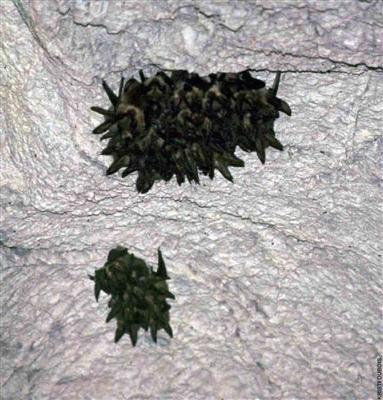
A Colony of Townsend's big-eared bats
"A univocal term is not merely a common designation, it also states that what is said univocally of two objects is possessed in the same way by both. Univocation implies, in other words, not only logical [intellectual, conceptual] but also metaphysical univocation." Lyttkens, 200. This is an important aspect of univocity. Univocity can refer to "terms," to intellectual "concepts," and to metaphysical realities, that is, the reality of things and how they exist, their "to be" or esse.
That is why univocal concepts, and certainly univocal metaphysical realities, cannot be applied to both God and creation. The "concept" of God is not univocal to the "concept" we have of any creature. The metaphysical reality--the "to be" or esse of God is not univocal with the "to be" or esse of creation. God and creation cannot be put together into a common univocal concept like one species of bat can with another species under a genus.
St. Thomas gives a number of reasons why univocal concepts cannot be predicated of God.**
- Univocity between creation and God is ruled out by the causal relation between God and His creation. In creation, the form of the effect (the cosmos) is not like its cause. What in God is one and simply and uncontingent (uncreated being or esse) is received by creation in a divided, particularized, contingent, and multiplicitous form (created being). For univocity to exist, the cause and effect must not be unlike.
- Univocity is ruled out because the mode of existence (modus essendi) between God and creation is not the same. The mode of existence is different between God and creation. Whereas God's essence (His "what") and existence (His "is" or "to be") are one and the same, in creatures there is a distinction between essence (the "what" of a creature) and its existence (the "to be" of a creature). God's essence is necessary existence ("I am who am"). The creature's essence is contingent existence. Therefore God and creature cannot be univocally related.
- For something to be univocal in concept means that there is "something existing in the same manner in several things." Lyttkens, 201. (These several things are called the univocata, those things which share in the univocal concept.) In other words, there must be something that may be jointly and similarly predicated or said of the univocalia--whether it be something related to genus, differentia with the genus, i.e., species, differentia within the species, properties of a species, or even accidents arising out of differentia numerica or different instantiations or individuations of a certain species, e.g., one man versus another man.*** However, there is no way that anything predicated of any created thing may be predicated univocally of God. God and creation are not univocata.
- Another reason given by St. Thomas is a bit more subtle. In an intellectual sense (secundum intellectum) things of which something may be said univocally are not completely unitary. But God is both in an intellectual or logical sense (secundum intellectum) and in the ontological sense (secundum rem) simple. Therefore, God and creation cannot be univocally related to each other.
- The univocal concepts obtained from abstraction of the various individuals (e.g., the concept of "bat" that man abstracts from his observation of a number of individual bats) has a quality that arises from such a concept, specifically, any particular instantiation of that concept is one of composition or one that is compound. Any particular bat may be said to be constituted of the concept bat + its individuation. No one bat has "batness" full and entire. For this reason, the concept of "bat" is simpler than the actual bat itself. Ontologically speaking (secundum rem), a bat is a compound of the universal plus the particular expression of that universal. However, God is absolutely simple, and there is no compound in Him. God is secundum intellectum and secundum rem the same and simple. "God is absolutely 'simple' (simplex)." Lyttkens, 202. Composition is something found only in the material world (composition of act and potentiality), whereas God is absolutely simple and not subject to composition (since He is pure act).
- The relation of creation to God the Creator precludes univocation of the two for another reason. This reason requires us to come to terms with the notion of "per prius et posterius." The words literally mean in a prior or posterior manner, but it appears to be shorthand for the notion that a concept may be applied to two objects, one in an absolute sense and to another in a relative, lesser sense, so that what is said "per prius" is said of the prime analogate in an absolute prior, total, superior, or more noble sense, and is said of the secondary analogate or analogates "per posterius" or in a relatively posterior, partial, inferior, or ignoble sense relative to the prime analogate. Rocca (2004), 137. Words that are used in such a manner--per prius et posterius--are not used univocally. To say something per prius et posterius is not to put the cart before the horse. However, to say something per poserius et prius would be to place the less important before the more important. A relationship of per prius et posterius applies when the lesser participates in the greater. Accordingly, the relationship between substances and accidents is one of per prior et posterius because accidents require the substance to exist and so participate in the substance. "Nothing can be said of God and [created] things in the same order, all must be said per prius et posterius. For all that is state of God is stated essentially, but of [created] things it is stated by participation. Univocal predication is therefore excluded." Lyttkens (1953), 203. God and his properties are one, and he possesses them absolutely. Contingent creatures are not so, their properties are distinct from their substance, and they do not possess their properties absolutely.
- In two things of which univocal concepts can be predicated, there is a commonality of essence, but not a commonality of existence (their "to be" or esse is distinct from their essence, which they share). Univocity does not include esse or the "to be" which is existentially different for every creature, and the distinction between essentia and esse allows for univocal concepts to be applied to more than one instantiation of that concept. However, in God the esse or "to be" of God is equivalent to his essence of essentia, and so univocity is precluded by the commonality of existence and essence.
*As a term, the word "bat" is equivocal in that it, among other things, it can mean a flying mammal of the order Chiroptera or an instrument with which to hit a ball. The various concepts of "bat" referred to by the equivocal term "bat," however, are univocal.
**These are summarized from the discussion in Lyttkens (1953), 200-04.
***These terms are scholastic terms referred to as the five predicabilia, or five things that may be predicated or said about a subject. They are genus, species, differentia, propium, and accidens. They are in decreasing order of generality. Thus, for man, his genus is "animal," his species is "homo sapiens" or "man," one of his differentia specifica may be his power of thought, a property of man is risibility or ability to laugh (a propium). Accidents are "a more occasional property varying from one individual to another," Lyttkens, 201 n. 7, in other words those arising from differentia numerica, and might include such things as one man being "black" and another being "white."

